NEWS
How Tractors Handle Australia's Harsh Farming Conditions
Press Release
If you spend any time on Australian farms, you quickly realise that not all farm tractors are built for the same world.
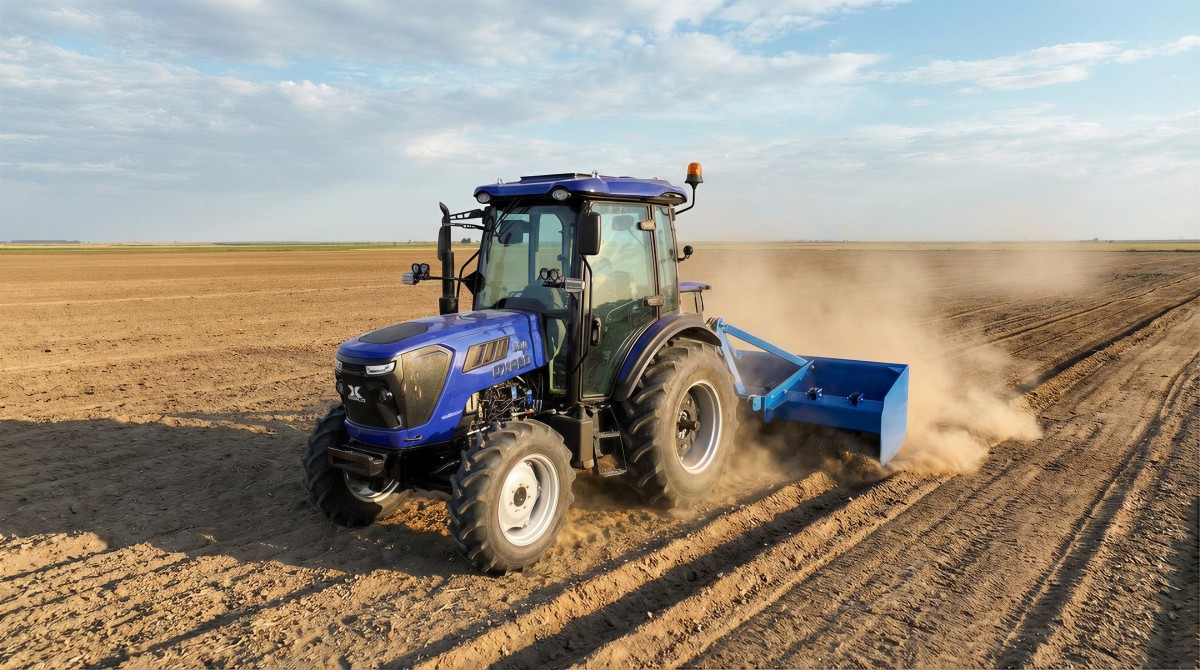
Machines that perform well in mild European climates or smaller properties often face a very different reality when operating as tractors in Australia. Long, dry summers. Air thick with dust. Wide paddocks that require hours of continuous operation. Heavy loader work that doesn’t stop just because the temperature climbs past 35°C.
At that point, tractors stop being just machines. They become work partners. And for tractors for agriculture working in Australia, durability is not a marketing word — it’s a daily requirement.
Heat: The First Real Test
Australian heat doesn’t just make operators uncomfortable. It quietly tests every cooling component inside a tractor.
Engines run hotter. Hydraulic oil thins out faster. Transmission systems carry sustained load under high ambient temperatures. When cooling systems are only designed for moderate climates, problems start to show — sometimes slowly, sometimes suddenly.
Reliable farm tractors operating in hot regions need more than a basic radiator upgrade. They need airflow that actually moves through the machine properly. They need cooling capacity that can handle hours of PTO work or loader operation without creeping toward overheating.
For tractors in Australia, heat management isn’t an optional feature. It’s part of whether the tractor can finish the job.
Dust: The Silent Wear Factor
If heat is visible, dust is not. But over time, dust can be just as damaging.
Across many agricultural regions, especially in dry inland areas, fine particles constantly surround working equipment. Air filters work harder. Hydraulic systems face contamination risk. Electrical connectors are exposed to repeated environmental stress.
We’ve seen that many issues in tractors for agriculture don’t come from dramatic failures. They come from gradual wear — dust entering where it shouldn’t, filters not sealing properly, components wearing earlier than expected.
That’s why well-designed farm tractors intended for Australian use require serious attention to sealing, filtration, and component protection. It’s not glamorous engineering, but it makes a measurable difference over years of use.
Workload and Scale: Built for Long Days
Another factor that separates tractors in Australia from many other markets is scale.
Properties are often larger. Work sessions are longer. Loader tasks—moving hay bales, feed, or materials—can go on for extended periods. Add uneven terrain and heavy implements, and the stress on the chassis and drivetrain becomes significant.
In these conditions, structural balance matters. A tractor that feels stable under load, distributes weight properly, and transfers power smoothly will naturally last longer.
Horsepower alone doesn’t determine whether farm tractors survive these environments. Frame strength, drivetrain matching, and overall system balance matter just as much.
How OXPLO Approaches Agricultural Tractors for Australia
At OXPLO, we don’t begin development by asking how large the engine should be. We start by looking at how the entire machine will function as a working unit.
For tractors for agriculture operating in demanding climates, that means:
Cooling systems designed for sustained high-temperature work
Reinforced filtration to manage dust-heavy environments
Chassis structures capable of handling continuous load
Powertrain components selected to match real working speeds and torque demands
Our farm tractors are developed as coordinated systems, not as a collection of strong individual parts. Because in reality, most long-term problems don’t come from one weak component — they come from imbalance.
When engineering is aligned with real Australian farming conditions, performance becomes more predictable. Maintenance becomes more manageable. And equipment becomes something operators can rely on season after season.
Engineering Matters Where Conditions Are Toughest
Anyone who has operated tractors in Australia understands that the environment quickly exposes shortcuts in design.
Heat will test cooling systems. Dust will test filtration. Heavy workloads will test structural strength. Over time, only machines built with proper system balance continue to perform consistently.
That’s why selecting farm tractors for Australian operations requires looking beyond simple specifications. The real question is whether the tractor has been engineered for the kind of work it will actually face.
Because in Australia, conditions don’t adjust to the machine. The machine has to be ready for the conditions.
Share to :
Inquiry
Our manager will contact you within 30 minutes of working hours.
Related products
 TD1004OXPLO is a professional tractor manufacturer offering a powerful 100HP tractor built for demanding agricultural work. Combining the strength of a large tractor with reliable engineering, this model delivers stable performance, durability, and efficiency for a wide range of farming applications.
 TB804OXPLO, an Australian machinery brand, offers a powerful 80HP tractor designed for demanding farm tasks. This versatile Australia tractor combines the strength of a large tractor with the maneuverability needed for small to medium-scale agricultural operations, delivering reliable performance and efficient daily work.
 TB704OXPLO Tractor, an Australian machinery brand, offers reliable compact tractors including its versatile 70HP tractor, designed for small-scale farming, property maintenance, and light agricultural work. The OXPLO tractor combines power, maneuverability, and durability for efficient daily operation.
 TE504Oxplo, a premier Australian construction machinery brand, offers a high-performance 50hp tractor engineered for maximum efficiency in small-scale farming and versatile agricultural tasks.